
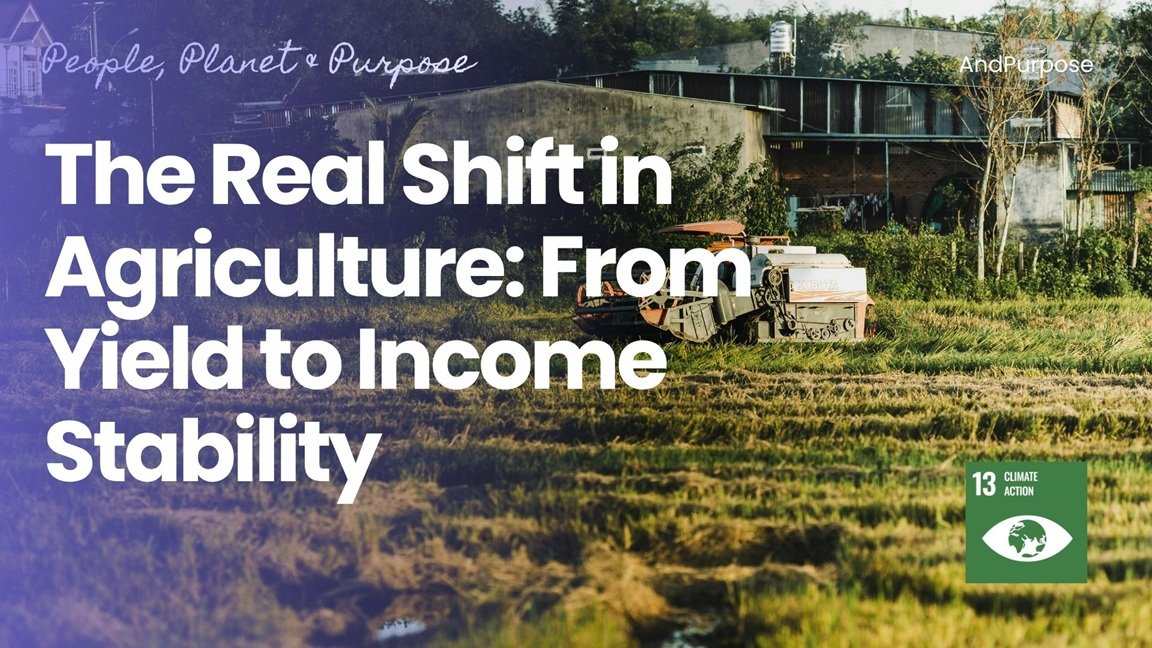
The Real Shift in Agriculture: From Yield to Income Stability
India doesn’t have an agriculture problem. It has an income stability problem, and soil lies at the centre of it.
For decades, agricultural success has been measured by yield. But for millions of farmers, higher output has not translated into stable incomes. Instead, rising input costs, declining soil health, and increasing climate variability are making farming more unpredictable and financially fragile.
Nearly 30% of India’s land is degraded (ISRO), while over 50% of farmland remains rain-fed (Ministry of Agriculture), leaving it exposed to erratic rainfall and climate shocks. Add to this the fact that over 85% of farmers are smallholders (Agriculture Census), and the challenge becomes clear:
This is not just about how much we grow.
It is about how reliably farmers can earn.
The Shift Beneath the Surface
India’s agricultural model has long been built on more inputs, more output: fertilisers, water, and chemicals, driving productivity.
But this model is showing strain.
Declining soil fertility is increasing dependency on chemical inputs, raising costs without guaranteeing proportional returns. At the same time, climate variability-heatwaves, irregular monsoons, and water stress-is making yields less predictable.
The result is a cycle:
Degraded soil → higher input costs → unstable yields → income volatility
What is emerging in response is not just adaptation, but a structural shift toward regenerative agriculture.
This approach rethinks farming systems:
- Soil-first, not chemical-first
- Restorative, not extractive
- Resilience-driven, not yield-maximising
The goal is not just productivity, but predictability, because for farmers, stable income matters more than peak output.
Why This Matters Now

The urgency is no longer theoretical-it is economic.
Farm incomes could decline by up to 25% due to climate change (Economic Survey)
52% of farmland is rain-fed and highly climate-sensitive (Ministry of Agriculture)
Rising input costs-fertilisers, diesel, irrigation-are increasing financial pressure
For smallholder farmers, who form the majority, there are limited buffers against these shocks.
This makes agriculture not just a sectoral issue, but a livelihood stability challenge.
Where the Real Impact Lies
The shift is most visible across Tier 2 and Tier 3 India, where agriculture is deeply tied to household survival.
Here, regenerative practices are not adopted as sustainability trends-they are emerging as risk management tools.
Improved soil health leads to:
Better water retention
Reduced dependency on costly inputs
More stable yields across seasons
In other words, soil health directly influences cost structures and income reliability.
🌱 Building Income Stability on the Ground

Some of the most meaningful innovation is happening at this intersection of soil health and farmer income.
Kheyti
Kheyti’s “Greenhouse-in-a-Box” enables smallholder farmers to grow crops in controlled environments, reducing exposure to climate shocks, lowering water usage, and improving yield consistency. The result is not just higher productivity, but more predictable income streams.
Boomitra
Boomitra uses satellite data to measure soil carbon and connects farmers to global carbon markets. By adopting regenerative practices, farmers can earn additional income through carbon credits, turning climate-positive behaviour into economic opportunity.
These models are important because they align sustainability with financial incentives, making adoption viable at scale.
What’s Actually Working
The strongest signal is not theory-it is adoption.
Programs like Andhra Pradesh Community Managed Natural Farming (APCNF) (apcnf.in) are demonstrating that regenerative practices can:
Reduce input costs significantly
Improve soil health over time
Increase farmer resilience to climate variability
Similarly, digital platforms like e-NAM have connected 1.7 crore+ farmers to markets (PIB), improving price discovery and reducing dependency on intermediaries.
What ties these efforts together is a shift from:
Input-intensive farming → knowledge and ecosystem-driven systems
The Scale of What’s Coming
This is not a marginal transition-it is structural.
India has 850M+ internet users, accelerating agri-tech adoption (IAMAI)
Government initiatives like the National Mission for Sustainable Agriculture are promoting climate-resilient practices
Carbon markets and climate finance are opening new income pathways for farmers
What This Means

India’s agricultural challenge is not just about growing more.
It is about earning more reliably from what is grown.
For the first time, climate urgency, policy, and innovation are aligning around a simple but powerful idea:
Healthy soil is not just an environmental goal.
It is an economic foundation.
The future of agriculture in India will not be defined by the highest yield in a good season, but by how consistently farmers can sustain their livelihoods across uncertain ones.
Because the real breakthrough won’t be what we grow-
But how well it supports those who grow it.
AndPurpose Grants

The Malta On-Farm Non-Productive Investments Grant supports farmers in implementing tree planting and biodiversity projects. With a €500,000 budget, it promotes sustainable agriculture, climate action, and ecosystem restoration through funding for environmentally beneficial farming practices.
Deadline: 29 May 2026

The Innovation Partnership Fund 2026 provides up to $20 million in behavioral health funding to support innovative, equity-focused solutions. Open to nonprofits, public, and private organisations, it aims to improve mental health systems, enhance service delivery, and address disparities through scalable, community-driven healthcare innovations
Deadline: 08 May 2026
Join the Conversation
We’ll take these themes forward at the AndPurpose Forums, Hyderabad 2026, bringing together leaders across agriculture, climate, technology, and policy to explore how regenerative systems can scale across India.
Because the question is no longer what to build.
It is how sustainably-and how widely-it can grow.
With Love & Purpose,
Team AndPurpose