
As 2025 draws to a close, the sustainability conversation is shifting in both substance and pace. Climate risk is no longer abstract. Social impact is no longer peripheral. Technology is no longer a support function.
Across sectors, decisions once framed as “responsible” are now directly tied to cost, continuity, and competitiveness. What’s emerging is not a single breakthrough, but a pattern: systems that can sense risk early, adapt in real time, and prove outcomes with data are pulling ahead.
From AI-enabled climate intelligence to circular material flows and resilient energy infrastructure, sustainability is becoming operational, measurable, and tightly linked to performance. This edition looks ahead to 2026, not as a distant horizon, but as the next execution cycle, mapping the signals shaping how impact, planetary health, and technology intersect in practice.
Why Now?
India’s climate trajectory is already shifting in measurable ways. In 2024, the India Meteorological Department confirmed the country experienced its warmest year on record, with average temperatures around 0.65°C above the long-term baseline, the highest since nationwide records began in 1901. (Down To Earth)
At the same time, India’s clean-energy transition is accelerating. Installed renewable capacity crossed 220 GW by early 2025, driven largely by record solar and wind additions supported by policy incentives. While coal remains a major electricity source, renewables now account for a substantial and growing share of generation capacity. (Press Information Bureau)
Digital infrastructure is scaling in parallel. India’s data centre capacity, currently near 950 MW, is projected to almost double by 2026, reflecting rising demand for cloud, AI, and digital services. These shifts matter because climate impacts and digital-energy transitions increasingly reinforce each other. (Wikipedia)
Rising temperatures are already shaping energy demand and peak electricity loads. Meanwhile, AI, cloud computing, and automation are adding new pressure to power systems. Together, they underline a central requirement: systems that can sense risk, adapt dynamically, and demonstrate outcomes with data, not intent.
Solutions Changing the World: From Ambition to Execution
Across sectors, the most meaningful climate and social progress is coming from solutions that move beyond pilots and scale inside real systems, energy grids, supply chains, cities, and ecosystems.
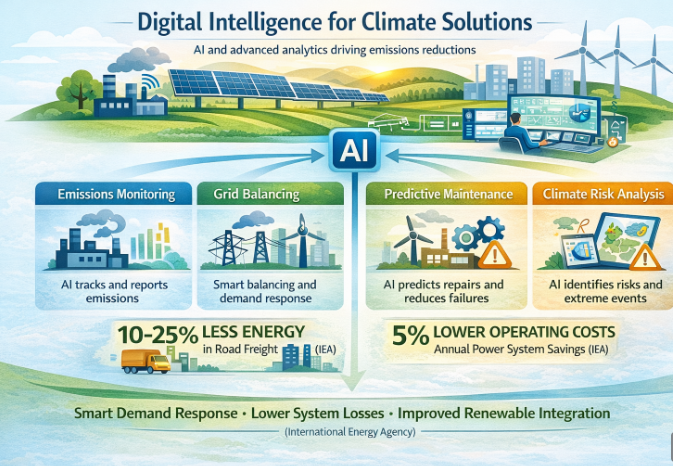 Digital intelligence is one such accelerator. AI and advanced analytics are now embedded in emissions monitoring, grid balancing, predictive maintenance, and climate-risk analysis. The International Energy Agency estimates that digitalisation can cut energy use by 10–25% in road freight, up to 10% in buildings, and reduce operating costs across power systems by around 5% annually. When deployed at scale, these gains translate into real emissions reductions through smarter demand response, lower system losses, and improved renewable integration, provided the energy footprint of digital infrastructure continues to decline. (IEA)
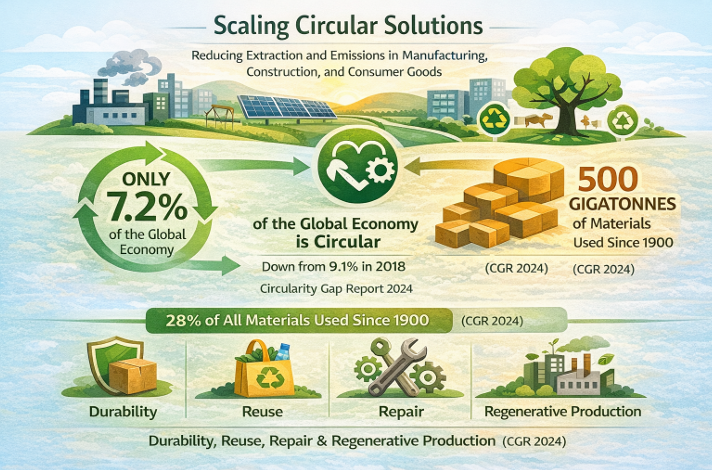
Circular systems are delivering similarly tangible signals while also exposing the size of the challenge. The Circularity Gap Report 2024 shows the global economy is now only 7.2% circular, down from 9.1% in 2018. In just five years, humanity has consumed over 500 gigatonnes of materials, 28% of all materials used since 1900. Solutions focused on durability, reuse, repair, and regenerative production remain among the fastest levers to reduce extraction pressure and embedded emissions across manufacturing, construction, and consumer goods. (CGR 2024)
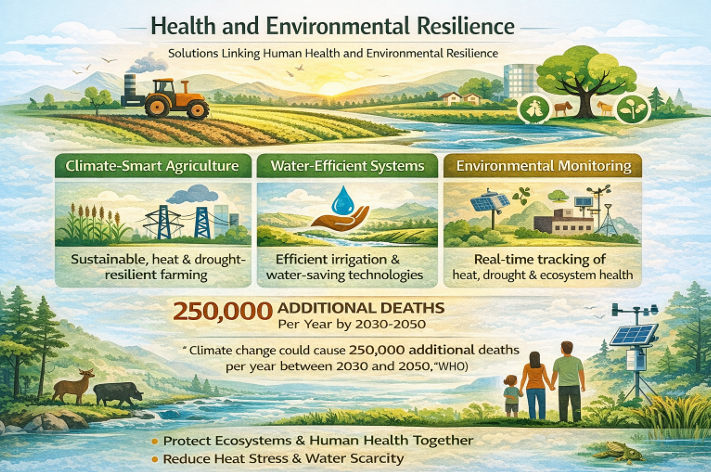
At the intersection of people and planet, solutions linking human health and environmental resilience are gaining urgency. Climate-smart agriculture, water-efficient systems, and real time environmental monitoring are strengthening resilience in regions already facing heat stress, water scarcity, and food insecurity. The World Health Organization estimates climate change could cause 250,000 additional deaths per year between 2030 and 2050, underscoring why climate action must protect ecosystems and human health together not as separate agendas. (WHO)
Startup Spotlight
Trinano Technologies Pvt. Ltd.

 Trinano is tackling a quiet but costly inefficiency in the clean-energy transition: underperforming solar assets.
The company has developed a patented solid-state 3D quantum cladding nano-coating that can be applied to virtually any solar panel regardless of make, type, age, or location. Once applied, the coating improves light transmission and surface performance, delivering an average 4% increase in energy output from day one.
Beyond higher generation, Trinano’s solution extends panel lifespan by 2–3 years and reduces cleaning frequency by nearly 50%, addressing one of the highest operational costs in large scale solar installations, particularly in dust heavy regions. By improving efficiency without new hardware or system replacement, Trinano offers a low-capex, retrofit-ready pathway to extract more value from existing solar infrastructure, strengthening returns while accelerating decarbonisation
AMP Robotics 

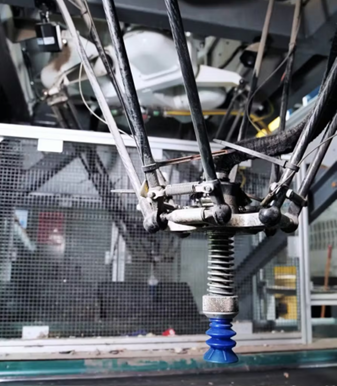
AMP Robotics is changing how the world handles waste not by asking people to recycle better, but by making recycling systems smarter. Using AI-powered vision systems and robotics, AMP automates the sorting of recyclables at material recovery facilities, identifying plastics, metals, paper, and cartons at speeds and accuracy levels humans can’t sustain. The result is higher material recovery, lower contamination, and recycling plants that actually perform at scale.
AMP’s systems are already deployed across hundreds of facilities in North America, Europe, and Asia, helping operators recover more value from waste streams while reducing dependence on manual labour. At a time when global circularity is stalling, AMP focuses on where the system breaks down most often: inside the infrastructure itself.
Hottest Grants this Week
AndPurpose Grants
 The British Ecological Society (BES) invites applications for its Outreach and Engagement Grants to support innovative public engagement with ecological science. Offering up to £2,000, the grant is open to BES members delivering creative, non academic outreach activities that raise awareness of ecology, ecological careers, and environmental action. Projects may use in-person or digital formats and must engage public audiences directly.
Deadline: March 10, 2026
 The Digital Freedom Fund invites applications to support strategic litigation advancing human rights in digital spaces across Europe. Open to NGOs, public interest organisations, and litigators, the grant funds both litigation and pre litigation research addressing issues like surveillance, data protection, algorithmic decision-making, and online freedoms. Grants are flexible, with average awards around €45,000. The call supports cases with wider legal and social impact.
Deadline: 17 February 2026
Looking Ahead
What links the signals in this edition is not ambition, but execution. Across energy, circularity, and climate resilience, progress is being driven by solutions that work inside real systems: retrofit technologies, data-backed intelligence, and infrastructure that performs better without waiting for perfect conditions. From extracting more value out of existing solar assets to fixing the weakest links in recycling infrastructure, momentum is shifting toward outcomes that can be measured, financed, and scaled.
As 2026 approaches, sustainability is no longer about adding parallel initiatives. It’s about making core systems work harder, cleaner, and smarter, and doing so at a pace that matches the realities of climate risk, resource pressure, and economic competition.
The work ahead is less about vision statements and more about choices: where capital flows, which technologies earn trust, and how quickly intent turns into operational change. We’ll continue tracking the solutions, signals, and builders shaping this next phase, where people, planet, and performance converge in practice.
At AndPurpose Forum Mumbai, builders, investors, and institutions came together around solutions already reshaping climate, livelihoods, and energy systems.
This edition sets the direction for the signals, stories, and execution-led updates we’ll continue to track ahead.

From Signals to Shared Action
Many of the solutions shaping this transition don’t emerge in isolation. They take form through collaboration between startups, operators, investors, policymakers, and communities working inside real constraints.
These conversations continue across the AndPurpose ecosystem, where practitioners and builders come together to exchange what’s working, what’s not, and what needs to scale next. More on that soon.
With Love & Purpose
Team AndPurpose