
People, Planet & Purpose – Social Startups Innovating for World’s Unique Challenges
Startup stories are often framed around scale, specifically how quickly solutions expand, the number of users they reach, and the amount of capital they raise. That lens misses a quieter shift now underway.
A new wave of startups is taking shape in sectors that define daily realities, including fragmented systems, uneven access, and mounting pressure on public infrastructure and social startups.
What distinguishes this moment is intent rather than novelty. Founders are moving away from pilot-driven impact toward models that can withstand regulatory scrutiny, public accountability, and real-world adoption. Innovation here is less about proving possibility and more about preserving function.
As 2026 unfolds, social startups are increasingly operating as system players. Their choices shape how first-time users access services, how risk is managed at the margins, and how resilience is embedded into already strained sectors.
This edition examines where that shift is most visible and what it signals for India’s next phase of problem-solving.
Why Now?
The conditions shaping India’s social startup ecosystem have shifted in measurable ways over the last three years.

India’s digital expansion has crossed the adoption threshold and entered population scale. With rural users now forming the majority of new internet growth, digital infrastructure is no longer urban-centric. This shift is reshaping how services from payments to healthcare and education are designed, delivered, and scaled across the country.
At the same time, environmental pressure is intensifying across districts, though not in uniform ways. A district-level climate risk assessment by India’s Department of Science & Technology (DST, 2023) identifies 51 districts at very high flood risk and 91 districts at very high drought risk, underscoring how climate shocks are increasingly disrupting agriculture, water availability, and livelihoods even without a single national aggregate figure (DST, District-Level Climate Risk Assessment for India).


Healthcare systems face parallel strain. Recent analyses show that non-communicable diseases accounted for approximately 63-65% of all deaths in India by 2023, up sharply from 37.9% in 1990. This shift toward chronic illness has placed sustained pressure on public health infrastructure that was historically designed around episodic care rather than long-term management (Drishti IAS synthesis of MoHFW & WHO data, 2023).
Capital behavior has also reset. After the post-2021 correction, India’s startup funding stabilised at USD 14.4 billion in 2024, up from USD 11.3 billion in 2023. Within this environment, focused startups accounted for roughly 10% of equity deals, with investors prioritising unit economics, adoption, and regulatory fit over rapid expansion (Entrackr, 2024, and Tracxn Environment Tech Report, 2024)

Together, these shifts are converging with policy anchors, including India’s expanding Digital Public Infrastructure, updated climate commitments, and sector-specific reforms across health, agriculture, and energy, creating clearer demand for solutions that integrate into national systems rather than operate alongside them.
As 2026 begins, social startups are not responding to abstract future risks. They are operating inside present constraints and building models that must function now, at scale, and under scrutiny.
Where Innovation Is Converging Across Systems
India’s most durable social innovations are no longer emerging within single sectors. They are forming at intersections where health, finance, agriculture, mobility, and climate resilience overlap and where system failures compound rather than appear in isolation.
A key driver of this convergence is applied AI moving from experimentation to infrastructure. NASSCOM’s AI Adoption Index 2.0 (2024) shows AI adoption now spans sectors, contributing nearly 75% of India’s GDP, with 87% of organisations in mid-to-advanced maturity stages. Deployment is concentrated in BFSI, healthcare, manufacturing, and public services, focused on diagnostics, fraud detection, demand forecasting, and compliance automation rather than consumer-facing novelty. (Nasscom).
Healthcare illustrates how cross-system design is taking shape. As chronic diseases account for nearly two-thirds of all deaths, startups are integrating diagnostics, care delivery, financing, and follow-up into single operational flows. An EY India healthcare survey (2024) reports that 48% of healthcare and pharma companies plan to integrate first-generation AI solutions within a year, primarily to address workforce shortages and operational bottlenecks, signaling a shift toward efficiency-led adoption.
Agriculture and climate resilience show similar convergence under pressure. A NITI Aayog-FAO assessment (2023) notes that climate variability now affects over half of India’s net sown area, accelerating demand for integrated models that link satellite data, climate forecasting, credit access, insurance, and logistics. Startups are responding by collapsing these layers into unified decision systems rather than fragmented services. (PIB)

US President Donald Trump addresses the United Nations General Assembly at U.N. headquarters in New York on Tuesday, Sept. 23, 2025 (NYT)
This convergence is further shaped by global climate realignments. In January 2026, the United States withdrew from the UNFCCC, IPCC, the India-led International Solar Alliance, and over 60 multilateral climate bodies, pausing emissions reporting, COP participation, and climate finance engagement. With the U.S. accounting for roughly 12.7% of global CO₂ emissions, this shift has weakened multilateral coordination and introduced new uncertainty into global climate financing and technology flows. For India, while near-term decarbonisation pressure may ease, risks are rising around clean energy investment, supply chains, and the estimated USD 2.5 trillion in climate finance required by 2030, intensifying demand for domestically resilient solutions in solar, adaptation, and agri-tech.
Mobility and logistics complete the picture. Invest India estimates that efficiency gains driven by digital logistics, EV services, and drone-based delivery could unlock up to USD 50 billion in value, largely by reducing fragmentation across supply chains serving agriculture, healthcare, and MSMEs. (Investindia).
Underlying all of this is financial infrastructure. UPI processed approximately 185.9 billion transactions in FY 2024–25, embedding payments directly into service delivery across sectors and enabling usage-linked, pay-as-you-go models at scale. (NPCI).
Taken together, these signals point to a structural shift. Innovation in India is no longer organised around sectors alone but around shared constraints, affordability, reliability, compliance, and integration with public systems. The social startups most likely to endure in 2026 are those built for this convergence, where impact depends on coherence across systems, not scale in isolation.
TERI World Sustainable Development Summit (WSDS) 2026
Innovation Partner: AndPurpose
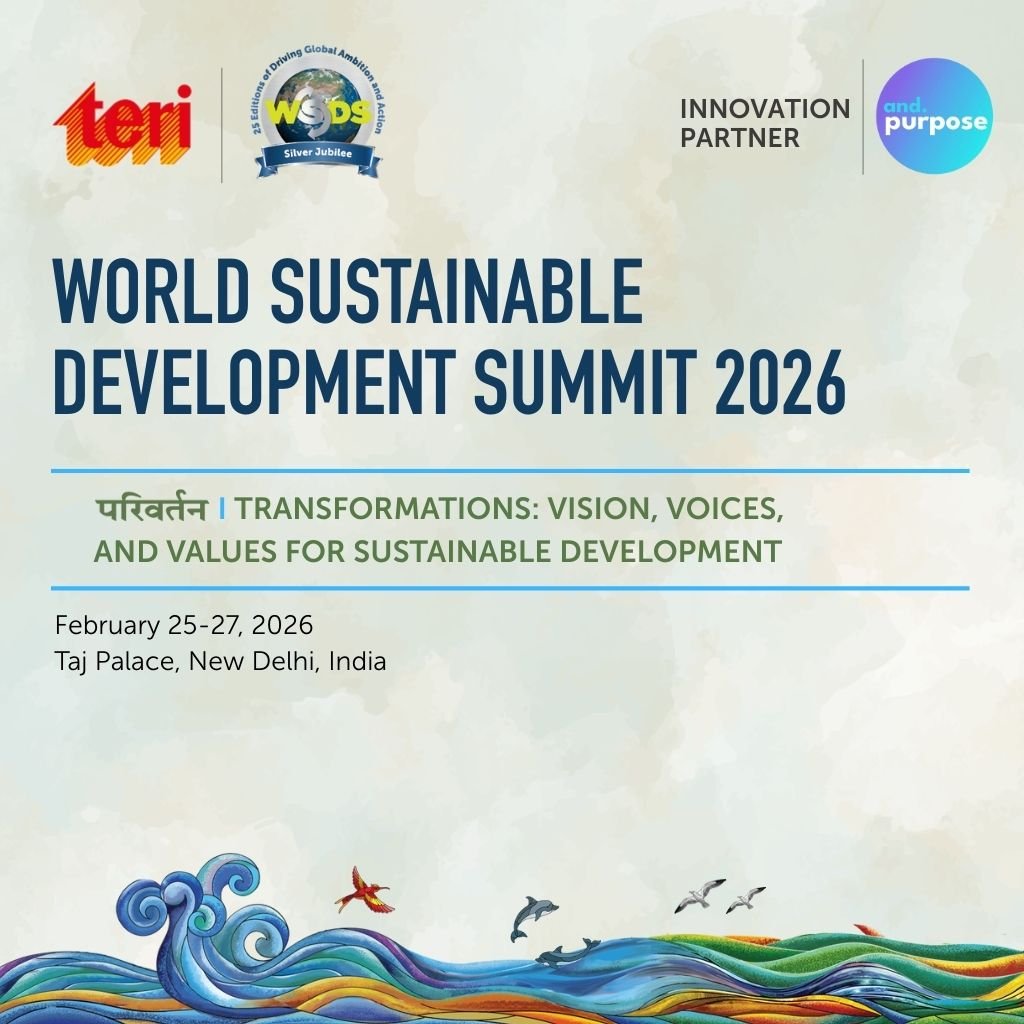
At AndPurpose, we are glad to join TERI for the Silver Jubilee edition of its flagship convening, the World Sustainable Development Summit (WSDS), scheduled to take place from 25-27 February 2026 in New Delhi, India as their Innovation Partners. The Summit will be anchored by the umbrella theme: ”परिवतॆन | Transformations: Vision, Voices, and Values for Sustainable Development.”
Over the past 25 years, WSDS has established itself as a leading global platform for dialogue on sustainable development, convening 59 Heads of State and Government, 149 Ministers, 13 Nobel Laureates, 2,158 business leaders, 3,730 speakers, and 41,889 delegates across its editions. The Summit continues to play a critical role in shaping conversations on climate action, development pathways, and institutional transformation.
Register here: https://luma.com/yvit8aik (*Zero fees, entry by selection only.)
To participate in the Startup Exhibit zone, write to us at hello@andpurpose.world (*Fees Apply)
For more information on WSDS 2026, visit: https://wsds.teriin.org/
UnPollute: Incubation

Women Climate Founders- This Is Your Moment 🚨
AndPurpose is glad to partner with Unpollute by STEP 🌎
If you’re building solutions in climate, sustainability, waste, water, energy, or circular economy, the UnPollute Incubation Program | January 2026 is where you belong.
🔥A 5-week, online, high-impact incubation designed exclusively for women entrepreneurs in climate action.
- Expert-led masterclasses
- Mentorship from climate & startup leaders
- Business clarity and investor readiness
- Opportunity to pitch at UnPollute Conclave 2026
- Access to funding pathways & national visibility
- Access to the startup toolkit worth Rs.20K.
If you’re a woman founder building in this space & passionate about scaling your climate venture, register now.
For queries, call: +91-9910493803
Hottest Grants this Week
AndPurpose Grants

The Jana Robeyst Trust Fund offers small grants of up to €1,500 to early career biologists and conservationists conducting field-based research on endangered mammal species in Sub Saharan Africa. The grant supports applied conservation research, essential field equipment, and limited travel for conferences or training. Open to applicants worldwide, the program prioritises projects with direct conservation impact.
Deadline: 30 April 2026.
The Lincoln P. Brower Awards, offered by the Monarch Butterfly Fund, provide USD 4,000 to support undergraduate and graduate students conducting research on monarch butterfly conservation and their habitats. Open to students in Canada, the United States, and Mexico, the award funds one-year research projects aligned with conserving monarchs across their breeding, migration, and overwintering range. Eligible expenses include research supplies, travel, and field assistance. Projects within the Monarch Butterfly Biosphere Reserve require official approvals.
Deadline: 31 March 2026

Looking Ahead
2026 is already separating relevance from reliability. As regulation tightens, climate stress compounds, and capital discipline deepens, social startups are being tested on execution rather than intent. The models that endure are those designed to function within India’s realities: fragmented delivery, uneven access, and sustained pressure on public systems.
We’ll continue tracking where this convergence holds, which models remain durable on the ground, and what that signals for founders, investors, and institutions working at the intersection of people, planet, and purpose.
With Love & Purpose
Team AndPurpose